
Healthcare systems require constant investment. Infrastructure, personnel, medicines, data systems, and supply chains all demand predictable funds. In low and middle income countries, public revenue rarely covers these needs. Foreign partners enter this gap. They bring capital, technical expertise, and access to pooled procurement. They fund disease programmes, immunisation campaigns, and system reforms. Without them, progress often slows or stalls entirely.
For recipient governments, foreign support can accelerate timelines and stabilise fragile facilities. It can also alleviate immediate crises such as vaccine shortages, emergency care backlogs, or rural staffing deficits. But external funding is never neutral. It shapes priorities, influences governance and alters accountability structures. Universal healthcare financed partly from outside remains universal in mission but not fully sovereign in strategy.
Government-to-Government Deals and the Shift in Aid Models
Traditional health aid has long relied on non governmental organisations. NGOs delivered services, managed programmes, and reported outcomes to donors. Governments often coordinated, not controlled. Government-to-government health agreements change this structure. These deals route funding directly through state institutions. They strengthen public systems rather than parallel ones. They place responsibility for delivery on national governments.
This model has clear advantages. It improves alignment with national health strategies and enhances state capacity also reduces fragmentation. But it also raises the stakes.
In Kenya, the rollout of the Social Health Authority (SHA) illustrates complexity in practice. By early 2025, more than 17.8 million Kenyans had registered with the SHA a significant uptake. However, implementation has lagged in many counties. A recent scorecard found that only 30% of hospitals are operating effectively under the SHA system, with technical issues like portal downtime and delayed payments hindering service delivery.
Direct financing demands strong public financial management, transparent procurement, and credible oversight. Without these, inefficiencies that weaken domestic healthcare will also weaken externally funded programmes. Government to government deals do not remove risk. They relocate it.
The Hidden Risks of Foreign-Backed Healthcare Systems
Foreign partnerships can stabilise health systems. They can also create dependency. Large external injections may crowd out domestic investment. Governments may delay difficult fiscal decisions, assuming partners will fill gaps. When funding cycles end or priorities shift, systems face sudden strain.
In Kenya, deeper structural challenges persist. Despite advancements, the health workforce remains deeply insufficient. A study across hundreds of facilities found an overall healthcare professional availability index of just 17.2%, with rural clinics especially understaffed. This shortfall is echoed in broader workforce data showing that the country falls far below the World Health Organization’s recommended minimum of 4.45 health workers per 1,000 population, with Kenya’s ratios often closer to 1 health worker per 1,000 people or lower particularly outside urban centres.
Financial hardship remains pervasive, too. Globally, about 2.1 billion people experience financial hardship when accessing health care, even where coverage improves. In Kenya, health inflation and a heavy reliance on out of pocket payments contribute to unaffordable costs for many, while contributory schemes struggle to expand coverage among informal workers. Foreign partnerships do not automatically address these underlying barriers. They support components of the system. They do not always change the fundamentals.
What Sustainable Universal Healthcare Requires
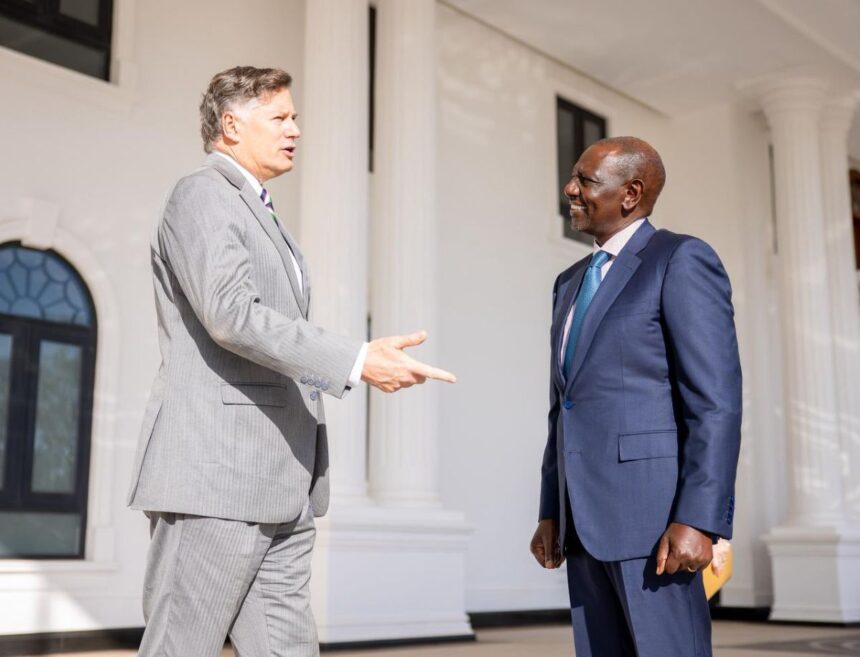
During a bilateral engagement in Nairobi, United States Deputy Secretary of State Christopher Landau framed health cooperation as a strategic pillar of Kenya US relations rather than a traditional aid arrangement. He pointed to large scale government to government health financing as evidence of a shift from donor driven interventions to state led system strengthening. The discussion underscored a broader US policy approach that links health financing to governance, accountability, and long term stability, rather than short term humanitarian relief.
Foreign partnerships can support universal healthcare. They cannot substitute for political commitment and domestic capacity. Sustainability rests on four pillars. First, domestic financing must grow. Tax systems, insurance schemes, and budget prioritisation determine long term viability. External funding should complement, not replace, national effort. Second, governance must improve. Procurement integrity, data transparency, and institutional accountability matter more than funding volume.
Third, partnerships must align with national priorities. Governments must lead, not follow. External support should strengthen systems, not dictate them. Fourth, exit strategies must be explicit. Every foreign funded programme should have a transition plan. Sustainability should be designed, not hoped for. Universal healthcare is not achieved through agreements alone. It is built through consistent policy, difficult trade offs, and institutional discipline. Foreign partners can accelerate progress. They can also delay essential reforms if misused. The balance between external support and domestic responsibility determines whether partnerships become bridges or crutches.