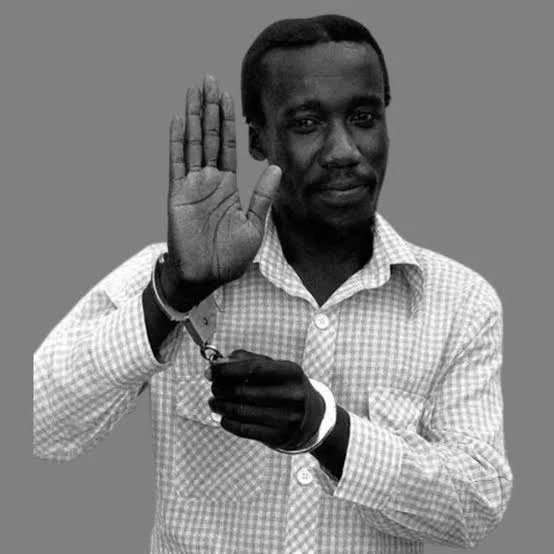
In Kenya’s post independence history, few events captured as much shock, controversy, and consequence as the 1982 attempted coup revolt. At the centre of that dramatic episode was Hezekiah Rabala Ochuka, a low ranking military man whose bold actions briefly thrust him into the nation’s spotlight. Though the coup lasted only a few hours, its reverberations shaped Kenya’s political and military landscape for decades.
Early Life and Military Beginnings
Hezekiah Rabala Ochuka was born on July 23, 1953, in Nyakach, in what was then Kisumu District (now part of Kisumu County). He came from a Luo family and grew up in a rural setting far from the corridors of power. Little is widely recorded about his early childhood, but like many young Kenyans of his era, he pursued a path that offered stability and purpose. In 1976, at the age of 23, he joined the Kenya Air Force (KAF).
Ochuka’s military induction began with basic training. He was sent to Lanet Army Barracks in Nakuru, where he completed an eight week course. Upon completion, he was posted to Eastleigh Air Base in Nairobi. His enlistment coincided with a period in Kenya when the armed forces were expanding and professionalising in the years following independence.
In the late 1970s, Ochuka received further training abroad. Between October 30, 1978 and January 21, 1980, he attended a technical training course in the United Kingdom at RAF Cosford. Upon return, he held the rank of Senior Private Grade‑I, the second lowest rank in the Air Force hierarchy. Despite his low rank, Ochuka was ambitious and eager to rise within military ranks.
The Roots of Discontent
By the early 1980s, political tensions simmered beneath Kenya’s surface. President Daniel arap Moi had succeeded Jomo Kenyatta in 1978, and his leadership style led to growing dissatisfaction among some segments of society and the military. Many junior officers, particularly in the Air Force, felt underpaid, overlooked in promotions, and frustrated with perceived inequalities compared to the Army. These grievances were a backdrop to the events that would soon unfold.
Ochuka was said to harbour strong opinions about the status quo. As some accounts suggest, he discussed his ambitions within military circles well before the coup, and he formed close alliances with other discontented servicemen. These included Senior Sergeant Pancras Oteyo Okumu and others who shared his belief that Moi’s government was failing the nation. Together, they began to plot a radical course of action.
The Plot and the People’s Redemption Council
In early 1982, Ochuka and select Air Force personnel began covert planning. Their aim was to overthrow President Moi and establish what they described as the People’s Redemption Council (PRC), a governing body that would replace the existing leadership. They secretly coordinated with officers across bases, gathered equipment, and prepared to seize key installations.
The plotters chose August 1, 1982, for the coup. In the early morning hours, a group of Air Force personnel took control of Eastleigh Air Base near Nairobi, followed shortly by the Embakasi Air Base. By around 6 a.m., Ochuka and Sergeant Okumu had the Voice of Kenya (VoK) radio station in their control, from which they broadcast their message to the nation. They announced that the military had overthrown the government and that Ochuka was now the chairman of the PRC.
The rebels went so far as to attempt enforcement of their authority through force. At Laikipia Air Base in Nanyuki, Corporal Bramwel Injeni Njereman reportedly forced Kenya Air Force pilots to fly fighter jets to bomb strategic targets, including State House and the General Service Unit (GSU) headquarters. However, the pilots turned the tables: understanding the gravity of their mission, they instead released their payloads over forests near Mount Kenya, preventing mass destruction.
The Coup Collapses
Though bold in conception, the coup was poorly coordinated and lacked broad support. Within hours, loyal elements of the Kenya Army, led by General Mahamoud Mohamed, as well as the General Service Unit and other loyal forces, moved decisively to suppress the rebellion. The rebellion was chaotic; communication breakdowns and disorganisation among the rebels undercut their ability to maintain control. By midday, loyal forces had regained key installations, and the coup’s momentum fizzled.
President Moi, who was outside Nairobi at the time, was secured and brought back to the capital. He appeared on state media to assure Kenyans that the government remained in control and to urge calm. Sporadic gunfire and clashes continued in parts of the city but were quelled within the day.
Aftermath: Trials and Punishment
After the coup, the government launched one of the largest security crackdowns in Kenya’s history. Officers detained hundreds of Kenya Air Force personnel. Authorities arrested more than 300 servicemen and put many on military trials. Ochuka and a few principal conspirators tried to flee, including a brief escape to Tanzania, but security forces captured, extradited, and court-martialled them.
The court convicted Hezekiah Ochuka and several key accomplices, including Sergeant Okumu and Corporals Bramwel Njereman and Walter Odira Ojode, of treason. Authorities executed them by hanging at Kamiti Maximum Security Prison in 1987, marking one of Kenya’s last uses of capital punishment.
The coup cost lives. Soldiers and civilians died in the clashes, and many more suffered injuries. Loyalist actions and subsequent detentions disrupted hundreds of families and reshaped military careers.
Repercussions for Kenya’s Military and Politics
The 1982 coup attempt was a turning point for Kenya’s military and political landscape. In the immediate aftermath, President Moi moved to consolidate his authority, restructure the military, and purge dissident elements. The Kenya Air Force was disbanded and renamed the ’82 Air Force, with tighter oversight under the Army — a move intended to prevent another internal uprising.
Beyond structural changes, the coup reinforced Moi’s political grip. It provided a rationale for constitutional amendments that strengthened executive power and limited opposition voices. Civil liberties were restricted, and Kenya’s governance became more authoritarian for years following the event.
Legacy and Lessons
Today, Hezekiah Ochuka’s legacy remains controversial. Some view him as an ambitious figure whose miscalculated gamble revealed deeper anxieties within post‑colonial Kenya. Others see the coup attempt as a misguided and dangerous bid for power that threatened the nation’s stability. Regardless of perspective, the events of August 1, 1982, serve as a reminder of the complex interplay between military authority and political power in a young republic.
The coup also left lasting lessons about civilian oversight of the military, the importance of professionalism in armed forces, and the potential consequences when grievances are channelled into unconstitutional action rather than reform. Kenya’s subsequent reforms aimed to strengthen democratic institutions, though debates about governance and accountability continue.