
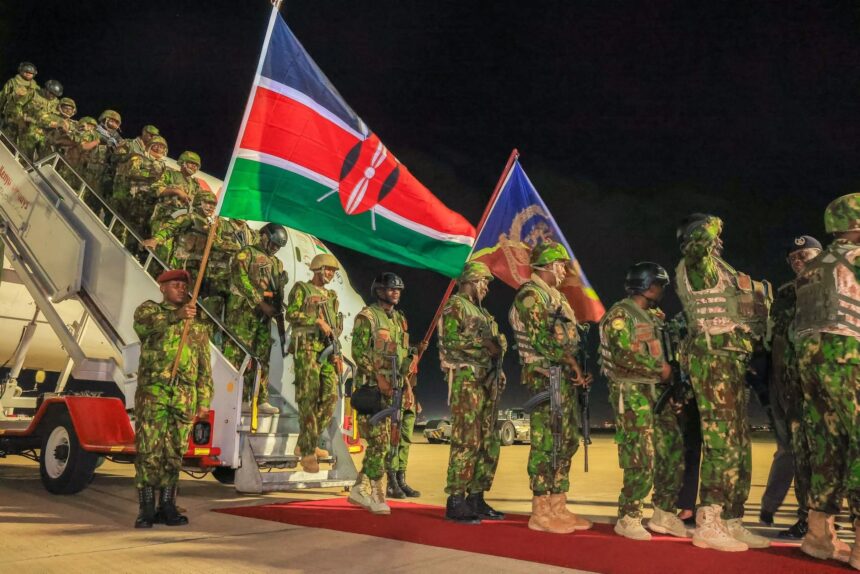
Deployment and Arrival in Haiti
In June 2024, Kenya sent its first police contingent to Haiti to support authorities amid rising gang violence and political instability. The team had 200 officers from elite units, including the General Service Unit (GSU), Anti Stock Theft Unit (ASTU), and Rapid Deployment Unit (RDU) of the Administration Police. Before departure, they trained extensively and coordinated with Haitian authorities. On 25 June 2024, they arrived at Toussaint Louverture International Airport in Port-au-Prince, marking Kenya’s first major deployment to the Caribbean. The officers quickly joined the Haitian National Police (PNH) and began joint operations while adapting to the urban environment, security threats, and logistical challenges.
Mission Objectives and Operational Impact
The mission operated under the Multinational Security Support Mission (MSS), later called the Gang Suppression Force (GSF). Kenyan officers aimed to restore public order in gang controlled areas, protect civilians and critical infrastructure, and enable humanitarian aid. They trained and mentored Haitian police officers to improve local capacity. Kenya led the mission to show its experience in international peacekeeping and focused on both immediate security and long term police development.
During the 18-month deployment, Kenyan officers reopened key roads and secured neighborhoods in Port-au-Prince, allowing civilians to move safely. They enabled humanitarian aid to reach affected communities and conducted joint patrols and raids with Haitian police. They also trained local officers in modern policing and crisis management. Observers praised their professionalism and respect for human rights. The mission strengthened public confidence in security forces and improved Kenya’s international reputation as a reliable peacekeeping contributor.
Challenges
The mission faced serious challenges. Gangs controlled large parts of the city, and limited personnel and equipment made operations difficult. Funding and logistical gaps slowed progress. On 23 February 2025, Officer Samuel Tompoi Kaetuai was killed in a gang related attack, becoming the first Kenyan officer to die during the mission. His death showed the dangers officers faced daily.
After 18 months, the first contingent returned to Kenya on 9 December 2025 and was welcomed by officials and family members at Jomo Kenyatta International Airport. Kenya deployed fresh teams to continue the operation under the GSF mandate. Each rotation ensured continuous support for Haitian authorities. Returning officers shared their experiences to improve domestic policing and future international deployments.
Long Term Impact
Kenya’s mission in Haiti left a lasting legacy. Officers gained skills in urban peacekeeping, crisis management, and international coordination. The mission strengthened Haiti’s police capacity through training and mentorship. Kenya demonstrated its ability to lead high risk peacekeeping missions. While gangs still pose a threat, temporary security improvements helped restore hope in some communities. The mission highlighted the limits of short-term interventions and reinforced Kenya’s role as a key contributor to global peace and security initiatives.
Also read: The Hidden Cost of Corruption: Looting Public Funds